
PART 3: The “Healing and Recovery” Peptides
BPC-157, TB-500 and GHK-Cu: Promising Science—or
Patients Getting Ahead of the Evidence?
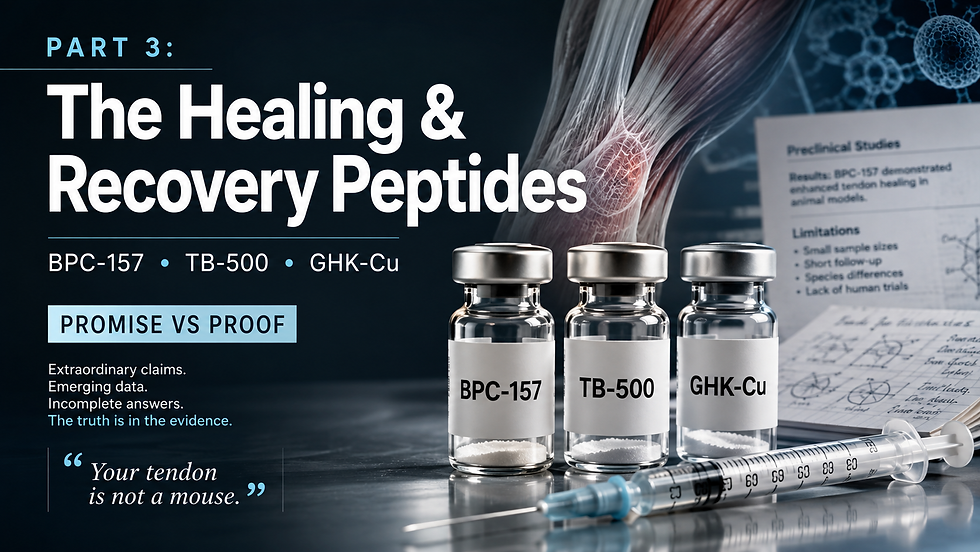
Your tendon is not a mouse, your injection is not a clinical trial, and an influencer testimonial is not a safety study.
By Alex Foxman, MD, FACP, ABOM
Double Board-Certified in Internal Medicine and Obesity Medicine
Founder and Medical Director, Beverly Hills Institute
“Doc, can peptides help my injury heal faster?”
This may be the question I hear most often about peptide therapy.
At gyms, med spas, wellness clinics and online, BPC-157, TB-500 and GHK-Cu are promoted as tools for repairing tendons, rebuilding ligaments, healing wounds, reducing inflammation and accelerating recovery.
The promise is extremely appealing.
Who would not want to recover faster from an injury, surgery or years of joint pain?
But the excitement surrounding these peptides has moved much faster than the human evidence.
BPC-157: The Internet’s Favorite
“Healing Peptide”
BPC-157 is a synthetic peptide containing 15 amino acids. It is commonly described as a fragment of a protective compound associated with gastric juice and was first synthesized by researchers in Croatia during the early 1990s.
It is not an FDA-approved medication.
It is promoted for:
Tendon and ligament healing
Muscle and joint recovery
Gut repair
Reduced inflammation
Postoperative healing
Much of the enthusiasm comes from laboratory and animal research.
In rodents, BPC-157 has been associated with effects on tendon, ligament, muscle and gastrointestinal healing. Proposed mechanisms include changes in inflammatory signaling, nitric oxide pathways, growth-factor activity and angiogenesis—the formation of new blood vessels.
That biology is interesting.
But interesting biology is not the same as a proven human treatment.
What Human Evidence Exists?
The FDA’s 2026 review identified only five small published human studies involving BPC-157. The routes and doses varied considerably:
Rectal administration in healthy participants
Rectal administration in patients with ulcerative colitis
Injections into painful knees
Administration into the bladder
Intravenous infusions in only two people
The studies were small, brief and exploratory. Safety monitoring was limited or unclear in several of them. A registered Phase 1 oral study was also identified, but results had not been posted and the FDA could not locate an associated publication.
Most importantly, the FDA did not identify clinical trials establishing that BPC-157 heals human tendons or ligaments. The agency specifically did not evaluate its use for tendonitis because adequate supporting information and relevant clinical studies were not available.
Pain relief is not proof of tissue regeneration.
A person may report less knee pain after an injection.
That does not prove that cartilage regenerated, a tendon repaired itself or a ligament became structurally stronger.
To establish healing, researchers would need appropriately controlled trials using meaningful functional outcomes and, when appropriate, imaging or other objective measurements.
Two People Are Not a Safety Trial
A 2025 report described two adults who received intravenous BPC-157 over two days without a serious short-term complication being observed.
That may be reassuring for those two people.
It does not establish safety for thousands of patients using BPC-157 for weeks, months or years. A two-person study cannot reliably identify uncommon immune reactions, cardiovascular effects, reproductive risks, organ toxicity or delayed complications.
This is a perfect example of how a technically accurate statement can become misleading online.
“BPC-157 was safely given intravenously to humans” sounds impressive.
“Two people received it for two days” tells the more complete story.
What About Angiogenesis and Cancer Risk?
BPC-157’s proposed ability to stimulate new blood-vessel formation is often presented as a reason it may help damaged tissue heal.
That same biological pathway also deserves careful long-term study.
This does not prove that BPC-157 causes cancer. However, FDA reviewers found no carcinogenicity studies and noted that its molecular targets and mechanisms remain poorly understood. Limited animal toxicology also produced signals involving clotting measurements and liver-related laboratory findings that require further investigation.
The responsible conclusion is not that BPC-157 is definitely dangerous.
It is that long-term risk remains inadequately defined.
Is the Product in the Vial the Same as the Research Compound?
Not necessarily.
FDA reviewers found inconsistent naming involving BPC-157 free base and BPC-157 acetate. These are distinct active pharmaceutical ingredients that may differ in stability, solubility, pharmacology and clinical effects.
The agency also identified gaps involving identity, purity, peptide-related impurities, aggregation, microbial quality and bacterial endotoxins.
So even when a study examines something called “BPC-157,” that study does not automatically validate every commercially sold vial carrying the same name.
For injected products, the questions extend far beyond whether the molecule might work:
Is it sterile?
Is the concentration accurate?
Has it degraded?
Does it contain bacterial endotoxins?
Were impurities adequately measured?
Peptides can aggregate during manufacturing or storage, potentially altering activity and increasing the risk of an immune response. FDA concluded that there is insufficient clinical information to characterize BPC-157’s safety and raised particular concerns about immunogenicity, aggregation and peptide-related impurities.
TB-500: Not the Same as Thymosin Beta-4
TB-500 is promoted for:
Tissue repair
Muscle recovery
Flexibility
Wound healing
Reduced inflammation
It is generally described as a seven-amino-acid fragment related to thymosin beta-4, a naturally occurring protein involved in cellular movement and tissue biology.
But this distinction is essential:
TB-500 is not full-length thymosin beta-4.
Research involving naturally occurring thymosin beta-4 cannot simply be applied to the smaller synthetic fragment marketed as TB-500.
In fact, the references submitted to the FDA in support of TB-500 involved thymosin beta-4—not human studies in which TB-500 itself was administered.
What Human Evidence Exists?
According to the FDA’s 2026 scientific review, NONE.
The agency found:
No human treatment studies
No human pharmacokinetic studies
No human pharmacodynamic studies
No clinical safety trials
No identified human exposure data through any route
FDA therefore concluded that TB-500’s potential risks in humans remain unknown.
That does not mean TB-500 has been proven harmful.
It means there is not enough reliable human evidence to determine whether it is safe or effective.
No reported side effects are not reassuring when there are no adequate human studies from which to report them.
FDA also raised concerns about impurities, peptide aggregation and immune reactions—particularly when TB-500 is administered by injection.
What the New FDA Advisory Vote Actually Means
In July 2026, the FDA’s Pharmacy Compounding Advisory Committee voted narrowly to recommend adding BPC-157 and TB-500-related substances to the 503A Bulks List, which could eventually permit qualifying pharmacies to compound them under certain conditions. FDA scientific staff had recommended against inclusion because of the evidence and safety gaps discussed above.
This was not FDA approval.
The advisory recommendation is nonbinding; the FDA has not completed its final determination, and the committee was considering eligibility for compounding—not proving that BPC-157 heals tendons or that TB-500 accelerates recovery. The FDA evaluated BPC-157 for ulcerative colitis and TB-500 for wound healing, not the full range of claims being made online.
Even if the FDA ultimately permits compounding, compounded drugs are not FDA-approved and are not reviewed before marketing in the same way for safety, effectiveness and quality.
A compounding pathway is not a clinical trial.
Greater access is not stronger evidence.
GHK-Cu: Topical Skin Science Is Not Injectable Anti-Aging Medicine
GHK-Cu is a naturally occurring copper-binding tripeptide promoted for:
Skin rejuvenation
Collagen production
Hair growth
Wound healing
Anti-aging
There is laboratory and animal research suggesting effects on inflammation, tissue remodeling and wound repair. Some topical products and small studies have explored cosmetic or post-procedure skin uses. However, much of the broader anti-aging narrative continues to rely on preclinical findings rather than large, high-quality human trials.
The route matters enormously.
Evidence involving a topical cream does not validate injecting the same peptide.
Topical application, microneedle delivery, subcutaneous injection and intravenous infusion create very different levels of exposure and potentially different risks.
The FDA specifically lists injectable GHK-Cu among compounded substances for which there are limited human safety data. It has raised concerns about aggregation, peptide-related impurities and possible immunogenicity.
A cosmetic ingredient applied to the skin should not automatically be transformed into a whole-body “longevity treatment.”
My Double Board Certified Physician Verdict
BPC-157
Scientifically interesting and worthy of legitimate human research.
Not supported by enough high-quality human evidence for me to recommend it as an established treatment for tendon, ligament, muscle, gut or postoperative healing.
If I wouldn't recommend this to my family, I am not going to recommend it to my patients.
The RISK still greatly outweighs the benefit.
TB-500
Even less supported.
FDA reviewers found no clinical studies or adequate human exposure data involving TB-500 itself.
I would not recommend its routine use outside a properly regulated clinical trial.
The RISK still greatly outweighs the benefit.
GHK-Cu
Topical use has a different—and somewhat more plausible—evidence and safety discussion than systemic injection.
Injectable GHK-Cu lacks sufficient human safety evidence for routine anti-aging, hair-growth or recovery treatment.
The RISK still greatly outweighs the benefit.
The Bottom Line
These compounds may have a future.
But today, the marketing remains far ahead of the proof.
Your tendon is not a mouse.
A reduction in pain is not proof of tissue regeneration.
Research involving thymosin beta-4 does not prove that TB-500 works.
A topical cosmetic study does not validate an injectable anti-aging protocol.
And an FDA advisory recommendation about compounding does not convert an experimental peptide into an FDA-approved treatment.
Your body deserves more than a theory, a testimonial and a vial.
It deserves real science.
Next: Part 4—Growth Hormone Peptides and the “Optimization” Market
CJC-1295. Ipamorelin. Sermorelin. AOD-9604. Tesamorelin.
Can manipulating growth-hormone pathways safely improve muscle, recovery, fat loss and healthspan—or are we activating powerful biological signals without adequately understanding their long-term consequences?
Evidence over hype. Science over social media. Patient safety first.
— Alex Foxman, MD, FACP, ABOM
Double Board-Certified in Internal Medicine & Obesity Medicine
Founder and Medical Director, Beverly Hills Institute
Current regulatory information as of August 3, 2026. This article is intended for general educational purposes and does not constitute individualized medical advice.


Comments